When the OK Corral Meets the Couple: Navigating Reconnection After Prostate Cancer
ARTICLE
Dr. Virgil Beasley, Psy.D.
11/12/20254 min read

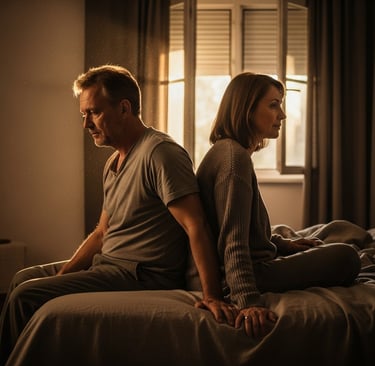
When prostate cancer enters a couple's life, it doesn't just affect one body—it fundamentally reshapes the relational dynamic between two people.
The diagnosed partner becomes the patient. The other becomes the primary support. Together, they navigate an experience that is simultaneously isolating and shared, frightening and hopeful, exhausting and transformative. Yet when treatment ends and the world celebrates survival, couples often discover an unexpected challenge: finding their way back to each other.
This is where the OK Corral—a foundational concept from Transactional Analysis—becomes not just a psychological framework, but a practical map for relational healing.
The Hidden Emotional Landscape of Survivorship
In my clinical work with couples navigating post-treatment life, I consistently observe a pattern: many men quietly migrate into what we call the "I'm Not OK, You're OK" position. This isn't a conscious choice—it's the emotional aftermath of losing perceived control over aspects of identity that our culture has historically tied to masculinity: physical strength, sexual function, and performance.
Beneath the surface runs a current of shame. I'm broken. She deserves better. I'm failing her.
These internal narratives drive withdrawal—not because connection has ceased to matter, but because the person feels fundamentally unworthy of it. Meanwhile, partners—often depleted from months of caregiving—may interpret this distance as rejection or disinterest. They begin to walk carefully, hesitant to initiate, afraid of applying pressure to something that feels fragile.
Without conscious awareness, both individuals drift into what I call a "dance of protective distance." Love hasn't disappeared—it's simply become trapped behind layers of fear and misunderstanding.
Understanding the OK Corral Framework
The OK Corral, developed within Transactional Analysis theory, describes four fundamental life positions that shape how we relate to ourselves and others:
I'm OK, You're OK — The position of mutual respect, authentic connection, and collaborative problem-solving.
I'm OK, You're Not OK — The position of blame, criticism, and relational superiority.
I'm Not OK, You're OK — The position of shame, inadequacy, and self-withdrawal.
I'm Not OK, You're Not OK — The position of despair, hopelessness, and mutual disconnection.
Following prostate cancer treatment, couples frequently oscillate between these positions without recognizing the pattern. A partner's well-intentioned comment—"I just want things to feel normal again"—may be received as criticism. A survivor's protective response—"I'm fine"—when they're clearly struggling only deepens the silence.
Understanding your current position in the OK Corral isn't about assigning fault. It's about cultivating awareness—gentle, honest awareness that creates space for intentional reconnection.
The Path Back to "I'm OK, You're OK"
The journey toward mutual okayness begins with what I call "courageous vulnerability"—the willingness to speak not just about the medical experience, but about the emotional truth beneath it.
"I feel us growing distant."
"I'm afraid you'll lose interest in me."
"I miss the us we used to be."
These statements aren't signs of weakness—they're demonstrations of relational courage. They signal that both partners are still reaching for connection through uncertainty.
When you can name your current position in the Corral—"I'm struggling right now and feeling not okay"—you create an opportunity for your partner to meet you there with empathy rather than react from their own anxiety. This single shift can dissolve months of accumulated silence. It transforms potential conflict into collaboration, guilt into mutual understanding, and bare survival into shared growth.
Clinical Observations: The Turning Point
In my therapeutic work with couples, the pivotal moments are rarely dramatic. They're often quiet, trembling exchanges that finally break through the protective walls both partners have built.
A husband says: "I'm terrified of disappointing you."
A wife responds: "I don't need you to perform for me—I just need you present with me."
In that exchange, both individuals step into the "I'm OK, You're OK" space. There's no pretense, no scripted roles—just two people remembering they're navigating this together.
This is the profound utility of the OK Corral framework: it provides language for what cancer disrupts—the fundamental sense of we're still a team.
Practical Steps Toward Relational Healing
Professional support—whether through couples therapy, cancer survivorship groups, or guided dialogue—can help partners recognize and shift these emotional patterns. The therapeutic goal isn't to erase what happened, but to intentionally create a new relational future.
Healing includes learning to exchange what Transactional Analysis calls "unconditional positive strokes"—genuine affirmations that communicate: I see you. Your worth hasn't changed. You still matter deeply to me.
It means choosing physical closeness over protective distance. Finding moments of lightness amid difficulty. Prioritizing honest communication over comfortable silence.
It requires understanding that intimacy encompasses far more than physical expression—it's about presence, patience, and giving each other permission to be authentically, imperfectly human.
An Invitation to Begin
If you're reading this as a cancer survivor or supportive partner, I invite you to pause and acknowledge something important: you've both navigated extraordinary challenges. You don't need to maintain a facade that everything has returned to "normal."
The OK Corral framework reminds us that healthy love doesn't require perfection—it begins when both people can genuinely hold the position of "I'm OK, and you're OK too."
Not flawless. Not without pain. Simply okay—fundamentally worthy, fundamentally connected.
That's where relational renewal begins: in the moment you choose to face each other again, not as patient and caregiver, but as two people still committed to loving courageously.
If this resonates with your experience, I encourage you not to hold it in silence. Begin the conversation—with your partner, with a therapist, or within your community. Healing genuinely starts with one honest word.