When Prostate Cancer Enters a Couple, It Never Comes for Just One.
ARTICLE
Dr. Virgil Beasley, Psy.D.
10/26/20255 min read
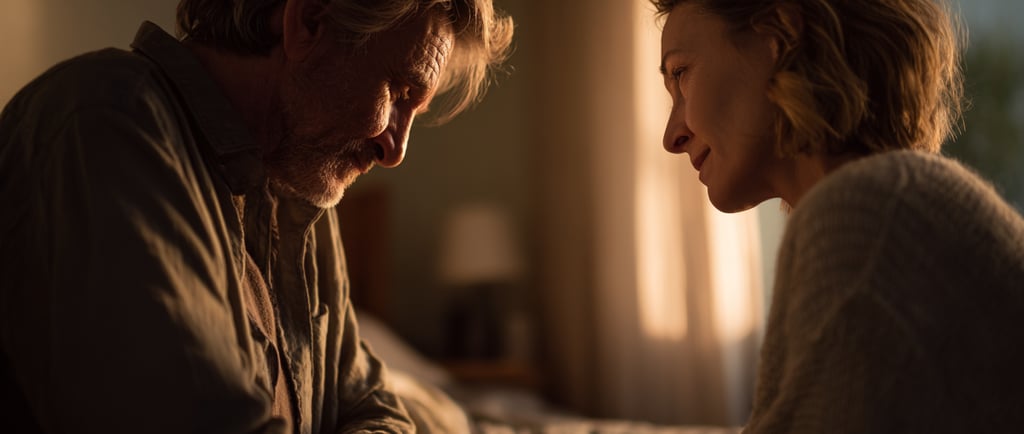
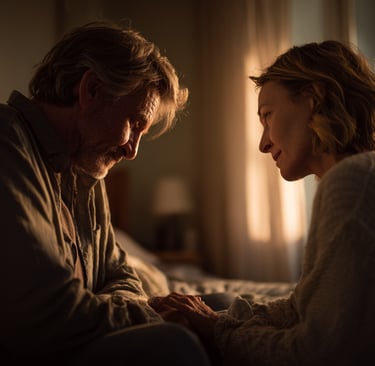
When prostate cancer enters a couple’s life, it rarely announces itself politely. It arrives like a storm — sudden, disorienting, and demanding every ounce of courage you have. The man becomes the patient, the focus of appointments, procedures, and test results. The partner becomes the anchor, holding everything steady while quietly weathering her own emotional hurricane.
In my work with couples, I’ve often seen what happens after the medical storm passes. He survives the cancer, and everyone exhales in relief. But then, unexpectedly, a different kind of silence moves in — the kind that fills the room when the machines are gone, the visitors stop calling, and the world assumes life has gone back to normal.
Only, it hasn’t.
He’s trying to make sense of a body that feels unfamiliar. You’re trying to make sense of a relationship that’s shifted in ways no one warned you about. The rhythm that once felt effortless now stumbles. And suddenly, both of you are standing on the same side of survival, yet miles apart — together, but unsure how to find your way back.
The Invisible Burden of Strength
I’ve sat across from partners who begin their stories with the same phrase: “He’s the one who had cancer — I shouldn’t complain.”
But what follows are tears, fatigue, and quiet guilt. They feel selfish for needing care after months of being the caregiver. They question their patience, their resilience, even their desire. They wonder why, if the cancer is gone, things still feel so fragile.
What I tell them is simple: you endured a trauma too.
When we speak of prostate cancer, we talk about survival rates and recovery plans — rarely about the emotional toll on the person who stayed strong through every appointment, every sleepless night, every change in intimacy. Yet the partner’s emotional recovery is every bit as vital as the survivor’s physical one.
The world applauds the survivor. But rarely does it recognize the quiet hero who steadied the ship while the waves were highest — the one who smiled through exhaustion, who sat beside the hospital bed pretending not to be afraid, who carried both hearts when one was too heavy to lift.
That unseen endurance deserves more than applause. It deserves healing.
The Silence That Separates
Many men, even those who fought bravely through treatment, struggle to talk about the aftermath. Embarrassment, changes in sexual function, and fear of disappointing their partner can make them withdraw. They may seem distant or irritable, but beneath that silence is often a deep sense of loss and confusion.
Partners misread that silence as rejection. Survivors interpret their partner’s quiet patience as pity. Both begin tiptoeing around each other, afraid to say the wrong thing, until connection is replaced by cautious distance.
It happens slowly — the way frost creeps over glass. One small silence after another. One unsaid word, one unasked question. And before long, two people who love each other deeply find themselves strangers in the same room.
Healing begins when that silence breaks — when both voices are heard. The partner’s voice matters not as background noise, but as part of the cure. The moment you speak, truthfully and without blame, is the moment light begins to return to the room.
Why Taking the Lead Can Heal You Both
Many survivors struggle to reach out first. Pride, fear, or the instinct to protect their partner from disappointment keep them quiet. That’s why I often encourage partners to take the first step — not to fix, but to invite.
Saying something as simple as, “I miss us. I want to find our new normal together.” can reopen doors that fear had locked. Words like that are not small; they are lifelines.
In therapy sessions, I’ve seen couples rediscover each other through honesty that felt impossible months earlier. When one finally dares to reach out, the other often rushes forward in relief — as though both had been waiting for permission to speak.
The courage to speak — gently, openly, without blame — often becomes the turning point in recovery. One brave sentence can melt months of distance.
Healing Together — Not in Silence
True recovery after prostate cancer happens on three levels: physical, psychological, and relational. Medicine can heal the body, but the relationship — the space between two people — often needs its own rehabilitation.
That space is where hope lives. It’s where love either grows or falters. And when illness has lived there for too long, rebuilding it takes patience — but it’s possible.
I’ve seen couples rebuild intimacy not by chasing what was lost, but by redefining what closeness means. A touch on the arm. A shared joke. A moment of vulnerability. These are not small gestures; they are the new language of connection.
Connection is not measured in performance, but in presence. It’s found in the quiet minutes before sleep, in laughter that returns like a shy friend, in the decision to sit a little closer even when words are few.
And when both partners participate — when each feels seen, valued, and safe — healing accelerates in ways no medical report can measure.
It becomes less about the scars that remain and more about the life that continues to unfold around them.
The Role of Counseling
Therapy provides a bridge when communication feels too heavy to cross alone. Individual sessions give each partner space to breathe — to acknowledge exhaustion, anger, or grief without guilt. Couple sessions, meanwhile, help both learn to listen again, to translate fear into understanding, and to rekindle intimacy without performance pressure.
It is not about pathology; it’s about permission — permission to feel, to ask, to rebuild. Counseling offers a structured space where both people can be human again, instead of roles: patient and caregiver, brave one and strong one.
I’ve witnessed remarkable transformations — couples who walked in sitting at opposite ends of the sofa and left holding hands, not because everything was solved, but because they could finally see each other again.
They rediscovered tenderness — that quiet warmth that says, I know you. I still choose you.
Sometimes healing begins not with a breakthrough, but with a shared breath — a sigh that says, We made it this far. Let’s start here.
To the Partner Reading This
You were his strength when he was too tired to fight. You held the hope when his body faltered. You carried the fear he couldn’t name and smiled when he needed courage.
And now, as he heals, you deserve healing too.
You are not invisible. You are not “just the partner.” You are a survivor in your own right — a quiet warrior who fought a battle no one documented.
It’s time for you to rest without guilt. To exhale without apology. To feel joy again without the shadow of vigilance.
Because recovery after prostate cancer is not about returning to what once was; it’s about discovering who you can become together.
The quiet bravery that carried you through the darkest days is the same strength that will guide you toward new closeness, deeper understanding, and shared healing.
Love has changed shape — but it hasn’t disappeared. It waits patiently, like sunlight behind the clouds, for both of you to turn toward it again.
Because when prostate cancer enters a couple, it never comes for just one.
He survived. You endured. Healing takes both.